

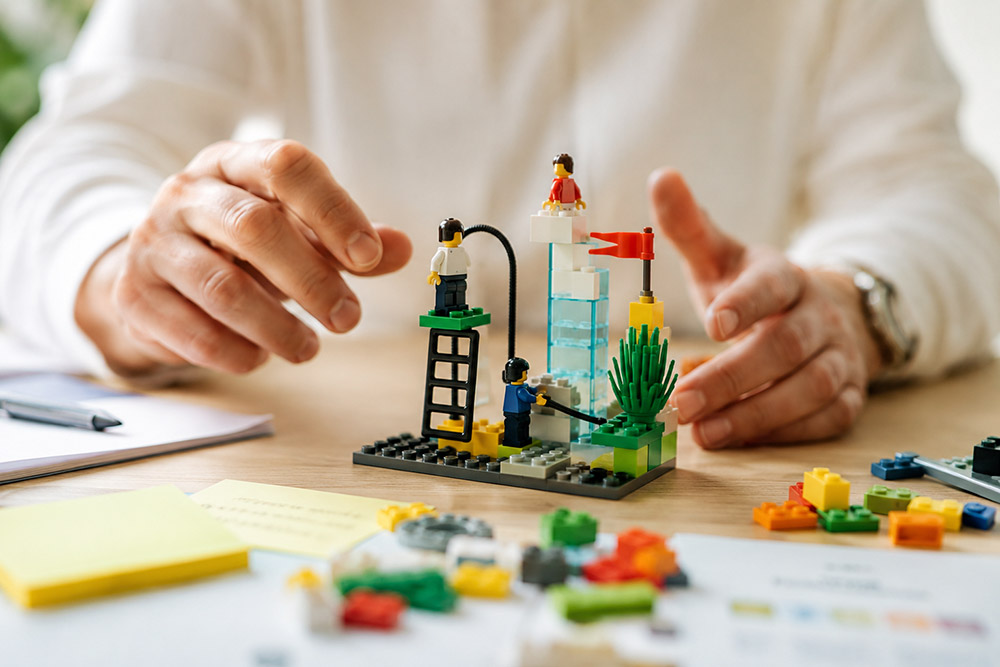
As a finance leader and coach, I rely strongly on rational thinking. When I want to understand or solve something, I ask questions, plan, calculate, look for connections, run scenarios and try to find the direction that may be the best fit for the situation.
At the same time, I always keep in mind that behind numbers, processes and decisions there are people: habits, fears, previous experience, trust, fatigue, motivation or sometimes the lack of it. It is the combination of rational analysis and human understanding that creates the full picture on which we ultimately base our decisions and actions.
Still, there are situations where that is not enough. The numbers look right on paper, the logic is clear, the project has been completed, the meetings have been held, yet the expected result does not materialize.
It may involve introducing a new system or product, a reporting dashboard, an AI application, an automation programme or a new operating model. The solution is in place, yet users continue to rely on their old, familiar ways of working or use only part of what it was designed to offer.
In these situations, we often hold another meeting, ask for more detailed status updates, refresh the action plan and follow up more closely. Sometimes this is necessary. But there are also situations where this is not what really moves things forward, because we still do not fully see why things are not actually changing.
When thinking is not enough
This is exactly why I wanted to learn to use a tool that does not rely only on the usual rational, analytical and argumentative ways of working.
This is why LEGO® Serious Play® caught my interest.
The point of the method is not whether someone is good at building with LEGO® bricks. It is not about whether the model looks good. What matters is that it has meaning for us. That it helps us express something we had previously only thought about, felt or struggled to put into words.
When I started building in response to a well-led question, I did not think in my usual way. I was not trying to immediately find a logical answer and I was not working on how to express my thoughts elegantly. I simply allowed my hands to work as well.
During the process, connections and patterns appeared that I probably would not have reached by thinking only or participating in a regular meeting.
This was also an important learning for me because we often think of creativity as inventing something completely new, something that did not exist before. But it is also creative work when we create a new connection from existing elements or when we look at a familiar problem from a different perspective.
From individual thoughts to a shared picture
It was even more powerful to see how it works in a team. Everyone built their own model, and then we built a larger one together from these individual models. Not by deciding who was right, but by making sure that what mattered to each person had a place in the shared model.
This is a very different experience from a regular business meeting.
In meetings, it often happens that someone formulates their thoughts faster, someone represents their view more firmly, someone has more organisational weight and someone else remains silent. In a well-facilitated LEGO® Serious Play® process, the aim is not to judge each other’s thoughts, but to understand who sees what.
By the end, we shared not only a model, but also a story
From a leadership perspective, this matters. A team often does not become committed simply because someone explains a plan well. Commitment is stronger when people have been part of how the model was created. If they can see their own perspective included, they can connect more easily to what later needs to be implemented.
Why is this relevant now?
In today’s business environment, there are many situations where the answers are not obvious. AI and automation, economic uncertainty, fast-moving competitors, cooperation across generations, constant transformation and change fatigue are all present at the same time.
In an AI or automation programme, for example, the question is not only what tool we introduce or which process we make faster. It is also whether people understand what it is for, whether they trust it, whether they see how it relates to their own work or whether they have the energy for yet another change.
These questions rarely rarely come to light in a single meeting. A LEGO® Serious Play® based process can show participants how they see a situation, where they feel uncertain and what may be needed for real change or impact to materialize.
For me, LEGO® Serious Play® does not replace rational thinking. It complements it. It does not say that we should not analyse, calculate or look at business impact and return. These are still important.
But there are leadership and organisational situations where it is worth bringing in another channel: hands-on, spatial thinking, metaphors, storytelling and shared building.
Sometimes a few LEGO® bricks can help us look differently at a problem we have been trying to solve for too long in our heads and in meetings.
If you would like to explore the background of LEGO® Serious Play®, you can read more on the official LEGO website.
If you want your team to open up about what usually stays beneath the surface and move forward together, take a look at Next Level BUILD.

If you are interested in the skills leaders will increasingly need, I can also recommend my article Future-ready leadership skills: Leadership development in a changing world.